
Personality analyses are now widely used in coaching, leadership development, teamwork and recruiting. This is also where PERSENTIS profiling comes in - with a special focus on self-reflection, role fit and interpersonal understanding. But what are the specific benefits? And where are the limits?
A low-threshold approach to self-reflection
PERSENTIS profiling is based on four non-judgmental behavioral tendencies: CONFIDENT, LIVELY, ATTENTIVE, CORRECT. It is not about pigeonholing or diagnostics, but about initial, practical impulses for self-knowledge. Many users experience an "aha" moment thanks to the short, easy-to-understand result profiles: "Yes, that's me - and now I understand why some things are easy for me and others are difficult."
It is precisely this low-threshold accessibility that makes the tool a valuable introduction to personal development - whether in coaching, onboarding or for determining where you stand before setting your career course.
What the PERSENTIS personality profile breaks down
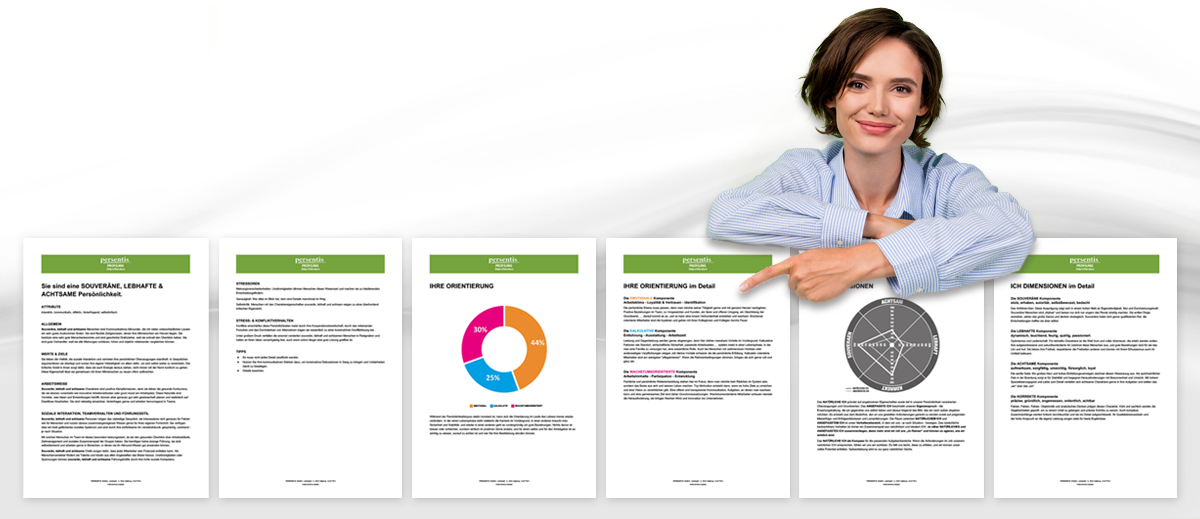
The result profiles offer a clear, differentiated and comprehensible presentation of individual behavioral preferences - without judgment, but with depth. The structure includes:
- General description of personality tendencies
- Values and goals that are typically in the foreground
- Preferred way of working and handling tasks
- Social interaction, team behavior and leadership style
- Individual stressors and
- Stress and conflict behavior
- Current orientation (weighting of the emotional, calculative and growth-oriented components)
- Ego dimensions (Natural / Adapted Ego)
This content not only provides orientation about your own impact, but also offers valuable starting points for dealing with others - in the team, in leadership or in contact with customers or guests.
Do not judge, but understand
A key advantage lies in the neutral, descriptive language of PERSENTIS profiling. It does not highlight strengths and weaknesses, but rather behavioral tendencies - differentiated and resource-oriented. The tool therefore promotes self-acceptance instead of pressure to optimize oneself. And it invites you not to evaluate differences between people, but to make use of them.
Matching: recognize fit, improve collaboration
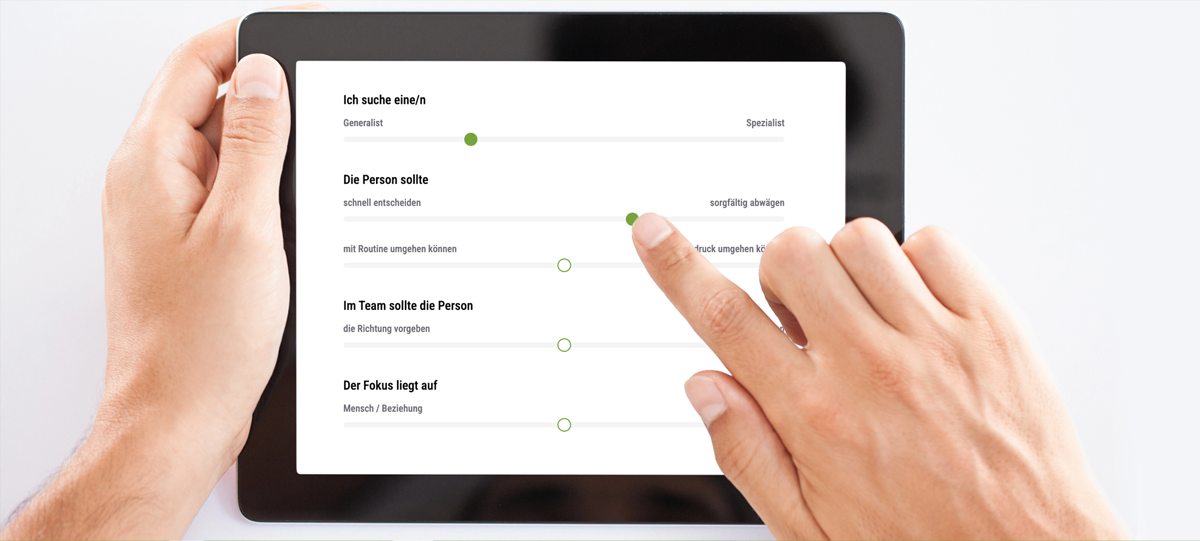
A particular field of application for PERSENTIS profiling is matching people with specific jobs. Companies can use the tool to define a target profile that describes certain requirements and desired behavioral characteristics of a position. The PERSENTIS system then calculates the fit between the target profile and the individual profiles of the applicants - well-founded, differentiated and clearly presented.
This makes it clear how high the chances of a successful working relationship are - whether in application processes, team composition or internal reallocations. The matching function creates transparency, supports better decisions and serves as a basis for dialog, understanding and realistic expectations.
Impulses for job and role fit
Even independently of matching, profiling provides orientation as to which tasks, roles or working environments someone thrives in - or chafes in. This is not a rigid recommendation, but a well-founded assessment of where you stand: if you recognize where energy is generated or lost, you can make career decisions more clearly and communicate more specifically what you need.
Managers also benefit: they understand more quickly why employees tick differently - and how they can activate their potential to suit the situation.
Strengthening team culture and communication
PERSENTIS Profiling opens up a common language for diversity within the team. It promotes understanding, improves cooperation and prevents misunderstandings - without any finger-wagging. Instead, it addresses questions such as: "How do we work together best, even though (or precisely because) we are different?"
Psychometric limits and conscious use
As practical as the tool is, it does not replace scientific personality diagnostics - and that is not the aim. The analysis is not used for the final assessment of people, but for self-clarification, team development and potential development.
It is important to use them consciously and responsibly: do not distribute labels, do not reinforce prejudices - instead, encourage reflection, motivate further development and understand fit as a shared task.
PERSENTIS Profiling is a powerful tool for clarity, matching and dialog - wherever people want to understand themselves better and become more effective in their interactions. It offers orientation without restrictions, opens up spaces for discussion instead of judgments - and has its greatest strength precisely where it is consciously used as a source of inspiration: clear, respectful and proven in practice.