DILIGENCE AND EFFICIENCY WITH THE CIP MODEL
“How can we evolve our work process to make work more effective while simultaneously improving quality?”
In the 1950s, automobile manufacturer Toyota asked itself precisely this question.
The goal: to continuously improve its operational processes in order to achieve high customer satisfaction and remain economically successful.
CHANGE FOR THE BETTER (KAIZEN)
This gave rise to the life and work philosophy of “Kaizen”.
At the heart of this philosophy is the continuous improvement of established processes. Systematically, in small steps, and in working groups.
In Toyota's case, Kaizen enabled a significant improvement in production rates and quality standards, making Toyota cars internationally competitive.
KAIZEN AND THE CIP
This Japanese management philosophy ultimately led to the Continuous Improvement Process (CIP), which plays a crucial role for Western companies to this day and serves as the implementation method for Kaizen.
Following Toyota's success, European and American car manufacturers also established the continuous improvement process. CIP is now also used in the service and administrative sectors.
“Continuous improvement is better than delayed perfection.” (Mark Twain)
SUCCESSFULLY INTRODUCING CIP INTO THE COMPANY
To ensure that the continuous improvement process is successful, it is primarily the responsibility of company management to create the appropriate framework conditions for implementing CIP. This includes providing working time and training opportunities. It is important to involve all employees, as they know the individual work steps best and can provide the most valuable suggestions for improvement.
Employees now form working groups, so-called “quality circles”, which meet regularly to discuss potential improvements. Weak points are then continuously improved in small steps. The focus here is not on maximizing profit, but on customer satisfaction and efficient working.
CIP MEASURES AND METHODS
For concrete implementation, various methods and measures exist, such as the PDCA cycle or the 5S method.
The PDCA cycle
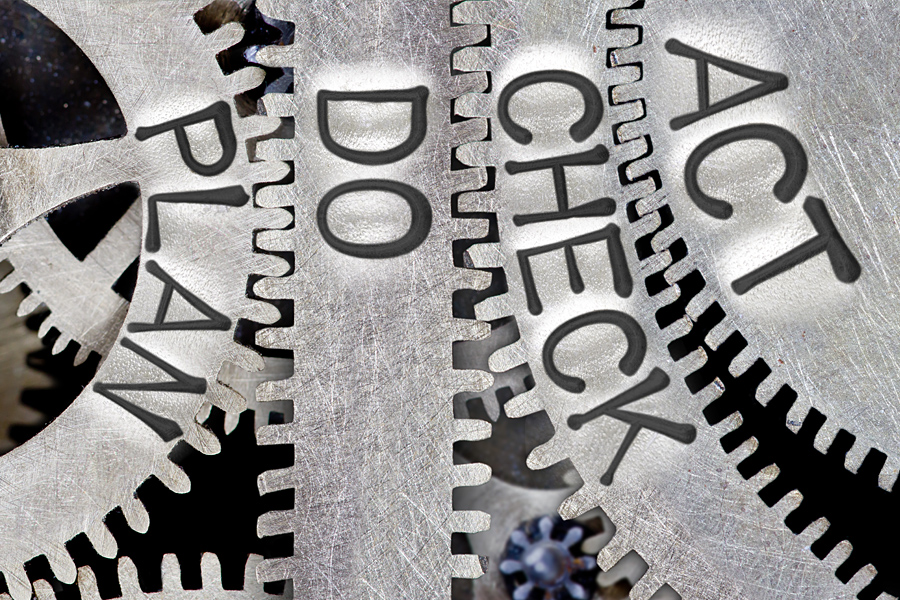
The PDCA cycle is the foundation of CIP and consists of the following four repeating steps:
- Plan: Analyze the current state and develop an improvement concept.
- Do: Implement the agreed measures.
- Check: Review and evaluate the results.
- Act: Introduce improvements and review them continuously
In the PDCA cycle, processes are closely observed and analyzed to identify potential improvements and derive concrete action measures. In practice, the model is used not only to improve products or services, but also for the new development of products, and is an essential component of lean management.
The 5S Method
The goal: To optimally design the work environment and establish standards and procedures, allowing employees to focus better on their actual work.

The 5 steps are:
- Sort: Analyze items at the workplace, separate frequently used items from unnecessary ones, and sort them out
- Set in order: Give every item a fixed place, arranged according to ergonomics and frequency of use
- Shine: Remove the causes of clutter and perform regular checks for deviations from the target state
- Standardize: Standardize the entire work area and document the arrangement of work tools
- Sustain: Maintain the organized and clear state
As part of Kaizen lean management, this method is now highly valued not only in production areas because the principle is easy to understand and apply. Employees gain a better feel for efficient work processes, know where their working materials are located, and can thus focus better and more efficiently on their own work.
Particularly analytically oriented employees, for whom working conditions are an important factor, will be enthusiastic about the introduction of CIP (Continuous Improvement Process) methods. This allows them to get actively involved right away, not only shaping their own working environment but also celebrating successes with higher efficiency and performance quality.